
Vacuum Machines
PROFESSIONAL GUIDE
Food vacuum packaging: understanding the different solutions and choosing professional equipment
Food vacuum packaging involves removing air from a bag or container before sealing it airtight. This technique is widely used by restaurants, caterers and food professionals for packaging, food preservation and preparing products for sous vide cooking.
There are two main types of machines for vacuum packaging food in bags or cooking pouches: chamber vacuum sealers and external suction vacuum sealers. Their operating principles and applications differ significantly.
There is also a particularly useful alternative for professional kitchens: vacuum packaging directly in Gastronorm (GN) containers. By using a universal vacuum lid and a compatible portable vacuum pump, existing stainless steel GN containers can be used for vacuum storage.
This solution is particularly suitable for delicate foods that should not be compressed and for ingredients stored in GN containers. It reduces handling and the consumption of disposable vacuum bags.
This guide explains how professional vacuum machines work, the main criteria for choosing the right equipment and the maintenance requirements to consider.
In this guide
01. How does a chamber vacuum sealer work?
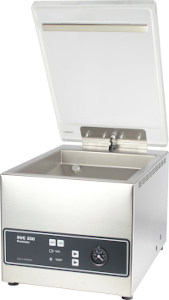
Example of a professional chamber vacuum sealer
Unlike an external suction machine, a chamber vacuum sealer requires the food and vacuum bag or sous vide cooking pouch to be placed entirely inside the vacuum chamber.
Once the lid is closed, the vacuum pump removes air from the chamber. When the programmed vacuum level is reached, the sealing bar creates an airtight seal across the opening of the bag or pouch.
Air is then reintroduced into the chamber. The resulting pressure difference causes the packaging to fit tightly around the food.
Key point: a chamber vacuum sealer can also package foods containing liquids, provided that the machine settings are adjusted appropriately.
02. Chamber vacuum sealer or external suction vacuum sealer?
Chamber vacuum sealer
The entire bag or pouch is placed inside a chamber. Air is removed from the chamber before the packaging is sealed.
Main advantages
- Suitable for solid foods and liquid preparations.
- Can achieve a high vacuum level, depending on the pump and settings.
- Compatible with smooth vacuum bags, sous vide cooking pouches and embossed vacuum bags.
- Well suited to regular professional use.
External suction vacuum sealer
The bag remains outside the machine. Air is extracted directly through the open end of the bag.
Main characteristics
- Generally more compact and less expensive.
- Primarily suitable for solid foods.
- Requires embossed or textured vacuum bags.
- Packaging liquids is more difficult and may require freezing the product first.
Our recommendation: for professional kitchens regularly packaging food in vacuum bags or sous vide cooking pouches, a chamber vacuum sealer is generally the most versatile solution.
03. Vacuum packaging in Gastronorm containers: an alternative to vacuum bags
In professional kitchens, food does not always need to be packaged individually in bags or cooking pouches. Prepared vegetables, fruit, cheese, meat, sauces and many other products can be stored directly in stainless steel Gastronorm (GN) containers.

Universal vacuum lids provide a practical alternative to transferring food into disposable bags. When combined with a compatible portable vacuum pump, they allow air to be removed directly from the GN container.
Advantages of this solution
- Use existing stainless steel GN containers, provided they are compatible with the lid.
- Less handling: food remains in its container, reducing handling-related contamination risks.
- No compression inside a bag: particularly useful for delicate foods.
- Reduced consumption of vacuum bags and cooking pouches for products stored in GN containers.
- Fast vacuum packaging with a suitable portable pump.
Unlike systems requiring specially designed vacuum containers, a universal vacuum lid makes it possible to reuse many stainless steel Gastronorm containers already available in professional kitchens. A compatible portable vacuum pump is required to operate the system.
This method does not replace refrigeration or food hygiene procedures. Its purpose is not to extend the validated shelf life of food, but to help maintain freshness during short-term storage, typically for up to 3 to 5 days, depending on the product and storage conditions.
04. Essential components of a chamber vacuum sealer
A chamber vacuum sealer must withstand significant pressure differences and repeated operating cycles. The quality of its components is therefore essential.
Vacuum pump
The vacuum pump is the heart of the machine. Professional models frequently use industrial oil-lubricated pumps. Their pumping capacity, expressed in m³/h, influences how quickly air is removed. A high-quality pump is essential.
Chamber and lid
The chamber must be robust and airtight. The lid may be flat or domed. A domed lid provides more height for bulky products but also increases the volume of air that must be evacuated.
Sealing bar
The sealing bar creates an airtight seal at the end of the vacuum cycle. Some machines feature two sealing bars to increase the number of bags or pouches processed per cycle. For additional security, certain manufacturers offer double-seal systems. The sealing bar length determines the maximum bag or pouch width that can be used.
Pressure sensor
On certain models, a pressure sensor allows the vacuum level to be controlled according to a target pressure, expressed in millibars (mbar), rather than by a fixed vacuum cycle time, as on simpler machines.
05. How to choose a professional vacuum machine
The right machine depends mainly on the dimensions of the food being packaged, the required production capacity and the available space in your kitchen.
Sealing bar length
A sealing bar measuring 200 to 250 mm is suitable for many individual portions. For hams, salmon and other large products, a 300 to 400 mm sealing bar or longer may be preferable.
Chamber capacity
A larger chamber can accommodate bulkier products, but takes longer to evacuate when pump capacity remains unchanged. Chamber size should therefore match the products you actually package.
Production capacity
Production capacity depends on the pump flow rate, chamber volume, sealing time and number of sealing bars. Multiple sealing bars can increase the number of bags or pouches processed per cycle.
Professional advice: also check spare parts availability, ease of maintenance and the manufacturer's reputation.
06. Maintenance and common vacuum machine problems
Regular maintenance helps preserve the performance of your vacuum machine and reduce unexpected downtime.
The vacuum pump is no longer working properly
An oil-lubricated pump requires periodic oil changes and, depending on its design, filter replacement. Always follow the manufacturer's maintenance recommendations.
The vacuum level is insufficient
A worn lid gasket may prevent the chamber from sealing correctly. Its condition should be checked regularly and the gasket replaced when necessary.
The protective sealing tape is damaged
The PTFE tape, often referred to as Teflon tape, protects the heating area of the sealing bar. Burn marks or visible damage may indicate that replacement is needed.
The vacuum bag or pouch is not sealing correctly
The problem may be caused by the heating element, protective tape or sealing bar mechanism. Some repairs require a qualified technician.
07. Is a chamber vacuum sealer costing less than €1,000 a good deal?
Some chamber vacuum sealers offer attractive specifications at competitive prices. However, the purchase price alone is not enough to assess the quality of a professional machine.
Pump reliability, chamber durability, sealing quality and spare parts availability are essential for regular professional use.
Before choosing a budget model, check the manufacturer's identity, maintenance options and access to replacement parts. A machine that costs less initially may become expensive if breakdowns interrupt your business operations.
08. Sous Vide Consulting's selection
For restaurants, caterers and food professionals, vacuum machine reliability is essential. Robust, properly maintained equipment helps ensure consistent production.
Sous Vide Consulting favours professional food vacuum machines designed and manufactured in Germany by established manufacturers.
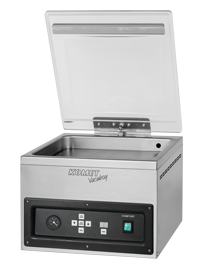
Komet Vacuboy chamber vacuum sealer

German manufacturing and expertise
Our catalogue is organised by sealing bar length to help you find a machine suited to your requirements.
09. Frequently asked questions about food vacuum packaging
What is the difference between a chamber vacuum sealer and an external suction vacuum sealer?
In a chamber vacuum sealer, the entire bag or pouch is placed inside a chamber from which air is removed. In an external suction vacuum sealer, air is extracted through the opening of the bag, which remains outside the machine.
Can liquids be vacuum packaged?
Yes. Chamber vacuum sealers are particularly suitable for liquids and foods containing juices. However, settings must be adjusted to reduce the risk of boiling or overflowing under reduced pressure. With an external suction vacuum sealer, packaging liquids is generally not possible unless the product has been frozen beforehand.
Can food be vacuum packaged directly in Gastronorm containers?
Yes. With a universal vacuum lid and a compatible portable vacuum pump, many stainless steel Gastronorm containers can be used for vacuum storage without disposable bags. This solution is particularly useful for delicate foods and ingredients stored in professional kitchens. Learn more about GN vacuum lids.
Which sealing bar length should I choose?
A sealing bar measuring 200 to 250 mm is suitable for many individual portions. For larger products, a 300 mm, 400 mm or longer sealing bar may be preferable.
Why is vacuum pump maintenance important?
Maintenance helps preserve pump performance and reliability. For oil-lubricated models, it includes oil changes and inspections recommended by the manufacturer. Oil changes should generally be carried out once or twice a year, depending on the machine and usage.
Which vacuum bags or cooking pouches should be used with a chamber vacuum sealer?
Chamber vacuum sealers typically use smooth vacuum bags for food storage and sous vide cooking pouches for cooking applications. Embossed vacuum bags can also be used in chamber machines.
External suction vacuum sealers require embossed or textured vacuum bags, which are generally considerably more expensive than smooth vacuum bags. For sous vide cooking, always choose packaging specifically rated for the intended cooking temperatures and duration.
Does vacuum packaging alone guarantee food preservation?
No. Vacuum packaging does not sterilise food and does not replace proper hygiene, cooling and storage procedures. Storage temperatures and durations must remain appropriate for the products and comply with applicable food safety requirements.